The Future of Global Logistics: How Technology Is Changing the Way Goods Mov
The movement of goods has always been one of the foundations of the global economy. From raw materials traveling between continents to packages arriving at a customer’s doorstep, logistics connects manufacturers, retailers, businesses and consumers around the world.
For centuries, moving goods depended heavily on human labor, physical infrastructure and basic communication systems. Today, technology is changing almost every part of that process.
A modern logistics operation can involve artificial intelligence, GPS tracking, cloud computing, automated warehouses, robotics, digital freight platforms, predictive analytics, electric vehicles and sophisticated inventory management systems.
These technologies are not simply making transportation faster. They are changing how businesses plan shipments, manage inventory, communicate with customers and respond to disruptions.
The logistics industry is entering an era in which information can move almost as quickly as the goods themselves.
What Is Global Logistics?
Global logistics refers to the planning and management of goods as they move through supply chains across different locations and countries.
A product can pass through several stages before reaching the final customer.
For example, a smartphone might involve raw materials from multiple countries, components manufactured in different regions, assembly somewhere else, transportation through international ports and warehouses, and finally delivery to a consumer.
This creates a complicated network.
Logistics companies must coordinate:
- Suppliers
- Manufacturers
- Warehouses
- Ports
- Airports
- Trucks
- Ships
- Rail networks
- Distribution centers
- Retailers
- Delivery services
- Customers
A delay at one stage can affect everything that follows.
This is why visibility and coordination are so important.
Technology is increasingly being used to connect these different parts of the supply chain.
How Technology Changed Logistics
The logistics industry has been adopting technology for decades.
Early improvements included telephones, computerized inventory systems and barcode scanners.
Later came GPS, electronic data interchange, online ordering and sophisticated warehouse-management software.
Today, logistics technology is moving toward more connected and automated systems.
Instead of simply recording what happened, modern systems can increasingly analyze what is happening now and predict what may happen next.
This distinction is important.
A traditional system might tell a logistics manager that a shipment is late.
A more advanced system might identify a developing delay, estimate its impact and recommend alternative transportation options before the shipment arrives at the next stage.
That shift—from reaction to prediction—is one of the most important developments in modern logistics.

Artificial Intelligence and Logistics
Artificial intelligence is becoming increasingly useful in logistics because transportation generates enormous amounts of data.
Every shipment can create information about location, timing, demand, inventory, transportation costs and delivery performance.
AI systems can analyze this information much faster than humans.
One major application is demand forecasting.
A logistics company needs to understand how many products customers are likely to purchase.
If a company stores too much inventory, it can face unnecessary storage costs.
If it stores too little, customers may experience delays or products may become unavailable.
AI can analyze historical sales, seasonal patterns and other data to help businesses make better forecasts.
The technology can also support route planning, warehouse operations, vehicle scheduling and supply-chain risk management.
The World Economic Forum has highlighted AI and advanced technologies as important tools for improving supply-chain resilience and visibility. (weforum.org)
Real-Time Shipment Tracking
One of the biggest improvements for businesses and consumers is real-time visibility.
In the past, customers might have had limited information about where their shipment was.
Today, GPS, connected devices and digital logistics platforms can provide much more detailed information.
A customer may receive notifications such as:
Shipment picked up
Shipment in transit
Shipment arrived at distribution center
Out for delivery
Delivered
For businesses, tracking provides even greater value.
Companies can monitor fleets, identify delays and understand where goods are located within the supply chain.
This information can help logistics managers respond more quickly to unexpected problems.
Real-time visibility can also improve customer service because businesses can provide more accurate delivery information.
The Role of GPS in Modern Transportation
GPS has become an essential technology for road transportation.
Fleet operators can use GPS to monitor vehicles and understand their locations.
This can support:
- Route planning
- Driver management
- Delivery tracking
- Estimated arrival times
- Fleet utilization
- Fuel management
- Vehicle security
Modern logistics platforms can combine GPS information with traffic data and mapping systems.
Instead of simply knowing where a truck is, a logistics manager can potentially estimate when it will arrive and determine whether it is likely to meet its delivery schedule.
This becomes especially valuable when managing large fleets.
A company operating hundreds or thousands of vehicles cannot rely entirely on manual monitoring.
Technology provides the visibility necessary to coordinate such operations.
Smart Warehouses Are Changing the Industry
Transportation does not begin when a truck leaves a warehouse.
A huge amount of logistics activity happens inside warehouses.
Traditional warehouses depend heavily on human workers to locate products, move inventory, prepare orders and load shipments.
Modern warehouses are increasingly using automation.
Robotic systems can transport products between different areas.
Automated storage systems can organize inventory efficiently.
Software can determine where products should be stored based on factors such as demand and frequency of orders.
This can reduce unnecessary movement and potentially improve warehouse productivity.
Companies such as Amazon have invested heavily in warehouse robotics and automation, demonstrating how technology is changing fulfillment operations at enormous scale. (aboutamazon.com)
However, automation does not necessarily mean humans disappear from warehouses.
Instead, humans and machines can increasingly work together.
People can focus on tasks requiring judgment and flexibility while robots handle repetitive physical activities.
Robotics and the Last Mile
The final stage of delivery is often one of the most challenging parts of logistics.
This stage is known as last-mile delivery.
It involves moving a product from a local distribution center or facility to the customer’s final destination.
The last mile can be expensive because deliveries are often spread across many different addresses.
A truck may have to make dozens of stops during a single route.
Technology is being developed to improve this process.
Potential solutions include:
- Delivery robots
- Autonomous vehicles
- Drones
- Smart lockers
- Route optimization
- Micro-fulfillment centers
The goal is not simply to make deliveries faster.
It is also to make them more efficient.
If a delivery company can reduce unnecessary driving and improve vehicle utilization, it may be able to lower operating costs while improving customer service.
Autonomous Vehicles and Freight
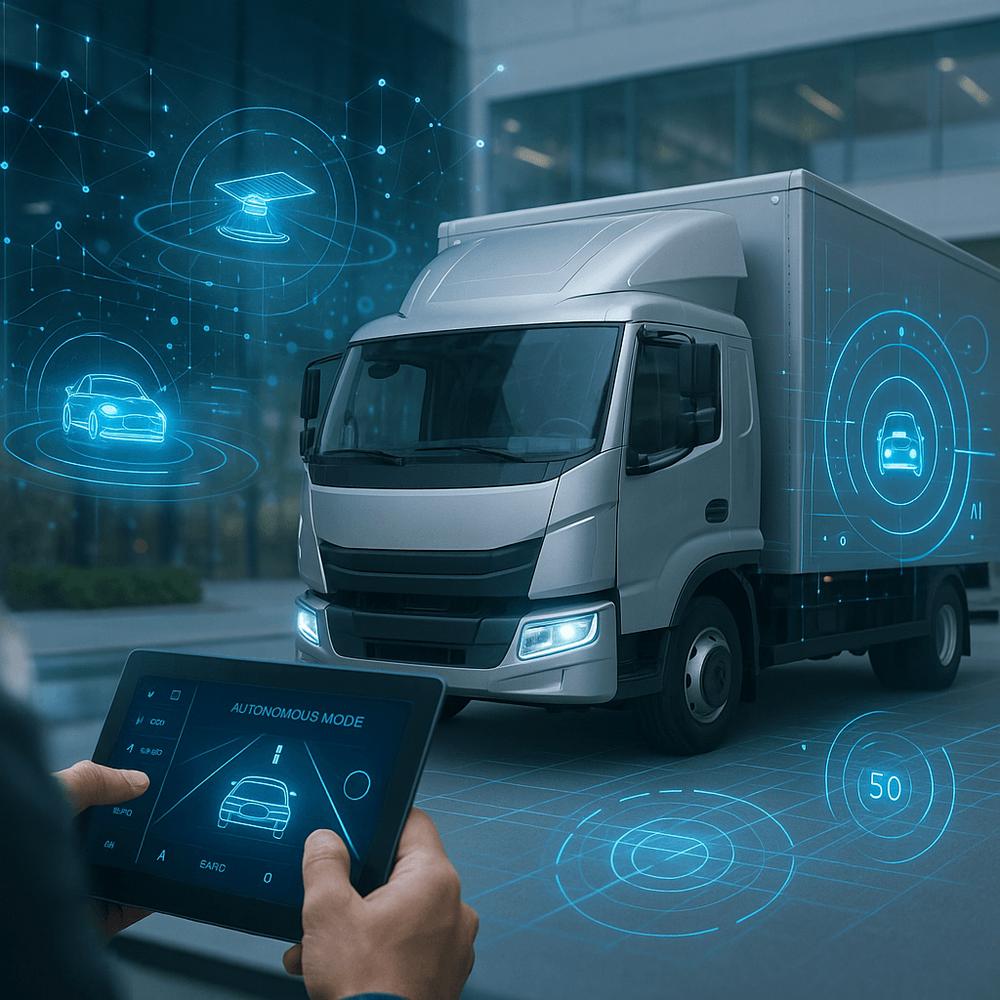
Autonomous driving technology could eventually have a major impact on logistics.
Long-distance trucking is one area receiving significant attention.
A truck that can operate autonomously for some or all of a journey could potentially reduce the need for continuous human driving.
However, autonomous freight transportation still faces significant technical, regulatory and operational challenges.
Road environments can be unpredictable.
Drivers must deal with weather, construction, pedestrians, other vehicles and unexpected situations.
Autonomous systems must be capable of responding safely to these conditions.
Despite the challenges, companies and researchers continue to develop autonomous transportation systems.
The International Energy Agency notes that autonomous driving is progressing alongside vehicle electrification and that commercial autonomous mobility services are already operating in some markets. (iea.org)
The technology could eventually become another tool available to logistics companies.
Electric Vehicles and Sustainable Logistics
Environmental concerns are also influencing the future of logistics.
Transportation is a major source of energy consumption and emissions, which has increased interest in electric trucks, vans and other commercial vehicles.
Electric delivery vans are particularly attractive for urban deliveries because they often travel predictable routes and return to a depot where they can recharge.
Electric trucks are also being developed for heavier applications.
The transition will not happen equally across every type of transportation.
Short urban deliveries may be easier to electrify than long-distance heavy freight.
Charging infrastructure, battery capacity, vehicle costs and operating conditions all influence the decision.
Still, the direction is clear: logistics companies are increasingly evaluating ways to reduce fuel consumption and environmental impact.
The Growing Importance of Digital Freight Platforms
Another major development is the rise of digital freight platforms.
Traditionally, arranging freight transportation could involve numerous phone calls, emails and manual processes.
Digital platforms can bring different parts of the process together.
A shipper can potentially:
- Enter shipment information.
- Compare transportation options.
- Receive pricing.
- Select a carrier.
- Track the shipment.
- Receive status updates.
- Manage documentation.
This can make freight transportation more transparent and efficient.
Digital platforms can also help match available transportation capacity with businesses that need to move goods.
Better matching can reduce situations where vehicles travel empty after completing a delivery.
That can improve fleet utilization and potentially reduce unnecessary transportation.
Blockchain and Supply-Chain Transparency
Blockchain has also been explored as a potential logistics technology.
At its simplest, blockchain provides a distributed record of transactions that can be difficult to alter retroactively.
In supply chains, this could potentially help organizations create shared records of events involving products.
For example, a company could record information about when goods were manufactured, shipped, received and transferred between different organizations.
The technology has attracted interest for applications where multiple parties need to share trusted information.
However, blockchain is not a universal solution.
A digital record is only useful if the information entered into the system is accurate.
Companies also need to consider cost, scalability, interoperability and data governance.
As a result, blockchain is likely to remain one tool among many rather than replacing traditional logistics technology entirely.
Predictive Analytics and Supply-Chain Risk
One of the biggest lessons from recent global disruptions is that supply chains can be vulnerable.
A problem at a major port, factory or transportation route can affect businesses thousands of miles away.
Predictive analytics can help companies identify potential risks.
For example, a logistics system could monitor:
- Weather conditions
- Port congestion
- Transportation delays
- Inventory levels
- Demand changes
- Geopolitical developments
- Supplier performance
The system can then help managers understand which parts of the supply chain may be at risk.
The World Economic Forum has emphasized that greater digital visibility and technology can help organizations strengthen supply-chain resilience. (weforum.org)
This represents a major shift in logistics thinking.
Instead of asking only, “Where is my shipment?”, businesses increasingly want to know:
“What could go wrong, and how can I prepare for it?”
The Human Side of Logistics Technology
It is easy to assume that technology will eventually eliminate the need for logistics workers.
The reality is more complicated.
Automation can replace some repetitive tasks, but logistics still requires people for planning, decision-making, maintenance, customer service and problem-solving.
Technology may therefore change jobs rather than simply eliminate them.
A warehouse worker might increasingly operate robotic systems instead of manually moving every product.
A transportation manager might spend less time tracking individual shipments and more time analyzing performance data.
Drivers may increasingly interact with sophisticated navigation and fleet-management systems.
This means digital skills are becoming more valuable across the logistics sector.
Cybersecurity Becomes More Important
Greater connectivity also creates new risks.
A modern logistics company may depend on dozens of digital systems.
These systems can control or support:
- Warehouses
- Vehicles
- Inventory
- Payments
- Customer accounts
- Shipment tracking
- Internal communications
A serious cyberattack could therefore disrupt physical transportation.
Cybersecurity has become an increasingly important part of logistics management.
Companies need to protect sensitive information and ensure that critical systems remain available.
They also need plans for recovering from cyber incidents.
As logistics becomes more digital, cybersecurity is no longer simply an IT issue.
It becomes an operational issue.
The Future of Delivery
Consumers have become increasingly accustomed to fast delivery.
Online shopping has changed expectations around speed, tracking and convenience.
Some customers expect next-day or even same-day delivery depending on the market and product.
Meeting these expectations requires sophisticated logistics networks.
Companies are therefore developing smaller distribution facilities closer to customers.
These facilities can shorten the distance between inventory and the final destination.
Combined with automated warehouses and route optimization, this could make fast delivery more practical.
However, faster delivery also raises questions about sustainability and cost.
Not every product needs to arrive immediately.
The future may involve giving customers more control over delivery preferences.
For example, a customer could choose:
Fast delivery: Higher cost, faster arrival.
Standard delivery: Lower cost, normal delivery speed.
Grouped delivery: Slower delivery designed to consolidate shipments.
Such options could help balance convenience, cost and environmental impact.
Logistics Will Become More Connected
Perhaps the most important trend is the increasing integration of different technologies.
GPS alone is useful.
AI alone is useful.
Robotics alone is useful.
Cloud computing alone is useful.
But when these systems communicate with one another, their value can increase significantly.
Imagine a logistics network in which:
A customer places an order.
AI predicts demand.
The warehouse automatically prepares the product.
Robotic systems move the package.
Software selects the most efficient transportation option.
A connected vehicle collects the shipment.
GPS tracks the journey.
The customer receives real-time updates.
The delivery route is automatically optimized.
The final delivery is confirmed digitally.
This is the direction in which logistics technology is moving.
The goal is a connected supply chain where information flows continuously between different stages.
What Will Global Logistics Look Like in the Next Decade?
Nobody can predict the future perfectly, but several developments are likely to influence logistics over the coming decade.
Greater automation
Warehouses and distribution centers will likely use more robotics and automated systems.
More electric fleets
Electric vans and trucks are likely to become increasingly common, particularly for predictable routes.
More artificial intelligence
AI will increasingly support forecasting, planning, routing and risk management.
Better shipment visibility
Businesses and customers will expect more accurate real-time information.
More autonomous transportation
Autonomous vehicles may gradually become part of commercial logistics operations.
More digital freight management
Paper-based and manual processes will increasingly move into digital platforms.
Greater focus on resilience
Businesses will invest more heavily in understanding and managing supply-chain risks.
More sustainable operations
Companies will continue looking for ways to reduce energy use, emissions and waste.
The Biggest Challenge Will Be Integration
The logistics industry does not have a shortage of technology.
The bigger challenge is making different technologies work together.
A company may have a warehouse-management system, fleet-management platform, accounting software, customer database and transportation-management system.
If these systems cannot communicate effectively, employees may still have to move information manually between them.
Successful logistics technology will therefore depend heavily on interoperability.
Companies need systems that can exchange information securely and reliably.
The future is not necessarily about having the most technology.
It is about having technology that works together.
Final Thoughts
Global logistics is undergoing one of the most significant technological transformations in its history.
Artificial intelligence is improving forecasting and planning. GPS is making transportation more visible. Robotics are changing warehouses. Electric vehicles are reshaping commercial fleets. Digital platforms are simplifying freight management, while autonomous technology could eventually transform how goods travel over long distances.
At the same time, businesses must deal with cybersecurity, regulation, infrastructure costs, sustainability and the changing role of workers.
The future of logistics will therefore not be determined by one invention.
It will be shaped by the combination of many technologies working together.
The most successful logistics networks will likely be those that can move goods efficiently while also providing visibility, flexibility, resilience and reliability.
For businesses and consumers alike, the result could be a supply chain that is faster to respond, easier to monitor and better prepared for unexpected disruptions.
The way goods move around the world is changing—and technology is at the center of that transformation.